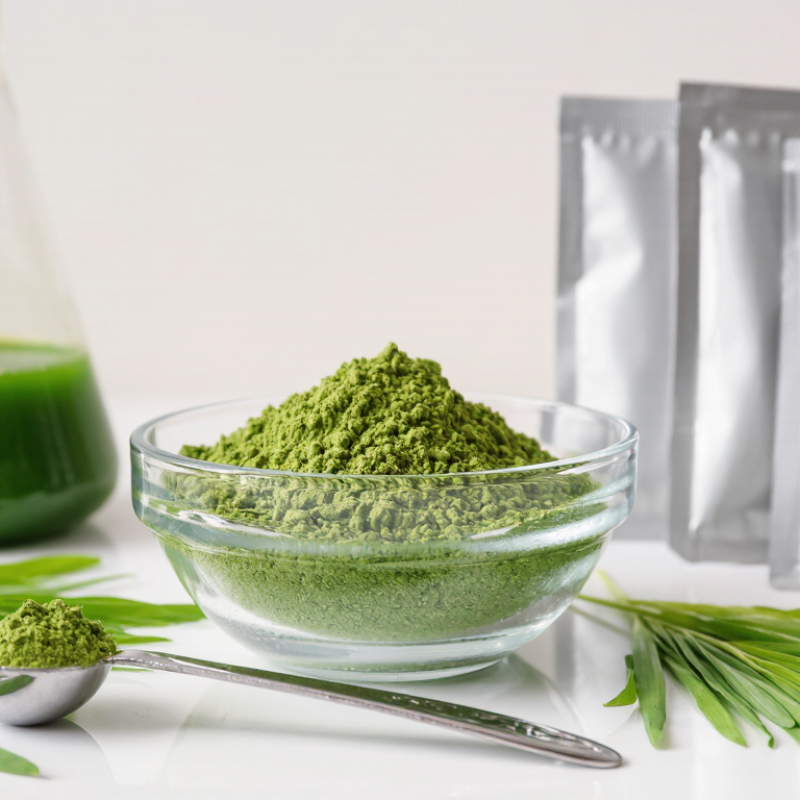
| Product Definition and Raw Material |
| Product identity | Barley grass juice powder is a dried powder made from the liquid juice expressed from young barley leaves (Hordeum vulgare L.). It is different from ordinary barley grain flour and from whole-leaf barley grass powder. | Buyers should confirm that the specification refers specifically to juice powder rather than milled leaf powder or cereal grain ingredients. |
| Typical harvest stage | Young barley grass is harvested before the plant reaches full grain maturity. The exact cutting stage varies by grower, climate, cultivar, and processing specification. | Harvest timing can affect color, flavor, fiber content, moisture, and the concentration of plant compounds. |
| Common cultivation regions | Commercial supply can originate from temperate agricultural regions in North America, Europe, Oceania, and Asia. Actual origin depends on the supplier’s farming network and production site. | Request the country of cultivation, country of processing, lot traceability, and agricultural production method for every shipment. |
| Agricultural production methods | Raw material may be grown under conventional, organic, or other controlled farming systems, subject to local regulations and certification requirements. | “Organic” should only be accepted when supported by a valid certificate issued by an authorized certification body. |
| How Barley Grass Juice Powder Is Produced |
| 1. Cultivation | Barley seeds are sown, grown, irrigated as needed, and managed until the leaves reach the supplier’s defined harvest stage. | Growing conditions, irrigation quality, soil management, and agricultural controls influence raw-material consistency. |
| 2. Harvesting | Young leaves are cut and transported for processing. Shorter time between harvesting and processing generally helps limit quality deterioration. | Ask about maximum transport time, temperature control, and controls against foreign material after harvest. |
| 3. Washing and sorting | The harvested grass is commonly inspected and washed with potable or otherwise controlled water to remove soil and other physical contaminants. | Suppliers should provide sanitation procedures, water-quality controls, and foreign-material prevention records. |
| 4. Juice extraction | The cleaned leaves are mechanically pressed or otherwise processed to separate liquid juice from much of the fibrous plant material. | The extraction method affects yield, insoluble fiber, texture, color, and the final powder’s dispersibility. |
| 5. Filtration or clarification | The extracted juice may be screened, filtered, or clarified to reduce coarse particles before drying. The exact sequence differs among processors. | Confirm whether the product is clarified, filtered, or retained as a more complete juice fraction. |
| 6. Drying | The juice is converted into powder using a controlled drying process, commonly spray drying or freeze-drying. A carrier may be used in some spray-dried products to improve processing and powder flow. | Ask for the drying method, carrier declaration, processing temperature range, and finished moisture specification. |
| 7. Sieving and blending | The dried material may be milled or sieved for a consistent particle size and blended by lot to achieve uniformity. | Particle-size data and blend records help assess solubility, mouthfeel, and batch-to-batch consistency. |
| 8. Packaging and storage | The powder is packed in moisture- and oxygen-protective food-grade packaging and stored in a cool, dry, controlled environment. | Packaging should protect the product from humidity, light, oxygen, and contamination during transport and storage. |
| Supplier Regions and Commercial Formats |
| North America | Suppliers in this region commonly serve food, dietary supplement, and ingredient markets. Products may be offered as conventional or certified organic material, depending on the producer. | Useful for buyers seeking established documentation systems, regional warehousing, and access to North American regulatory support. |
| Europe | European suppliers typically emphasize traceability, food-safety management, contaminant control, and compliance with applicable European food regulations. | Verify compliance with the destination market because European food and supplement requirements differ by product category and country. |
| Oceania | Oceania-based supply may include raw-material cultivation and processing for export markets, with documentation covering origin, farming practices, and quality controls. | Confirm whether the supplier controls cultivation directly or purchases grass or juice from external farms. |
| Asia | Asian suppliers may provide bulk powder, private-label processing, or contract manufacturing. Quality systems and agricultural origins vary significantly by producer. | Independent testing, factory audits, and complete batch documentation are particularly important when comparing different facilities. |
| Common commercial pack sizes | Bulk formats may include sealed bags, lined cartons, or drums. Smaller quantities may be packed in pouches, jars, or sachets for retail or food-service use. | Pack size should match expected order volume, shelf-life requirements, humidity exposure, and distribution conditions. |
| Quality, Safety, and Purchasing Criteria |
| Identity and authenticity | Documentation should identify the botanical material as young barley leaf juice and distinguish it from wheatgrass, barley leaf powder, barley grain, or blended greens. | Request botanical identity testing, ingredient composition, allergen information, and a clear product specification. |
| Moisture and water activity | Low moisture and controlled water activity help reduce the risk of caking and microbial growth. Limits are product-specific and should be stated in the specification. | Compare actual batch results with the agreed specification rather than relying only on general claims such as “low moisture.” |
| Microbiological testing | Typical testing may include total aerobic microbial count, yeast and mold, and specified pathogens such as Salmonella and Escherichia coli, according to the destination-market requirements. | Obtain a recent certificate of analysis for the exact lot and confirm the laboratory method and acceptance criteria. |
| Contaminant control | Relevant controls may include heavy metals, pesticide residues, mycotoxins where applicable, foreign matter, and other contaminants required by the destination market. | Testing frequency should be risk-based and supported by supplier qualification, farm controls, and laboratory reports. |
| Color and flavor | Authentic barley grass juice powder is generally green to green-brown and has a characteristic grassy or vegetal flavor. Color can vary with cultivar, harvest stage, oxidation, and drying conditions. | Use agreed color, odor, flavor, and dispersibility standards for incoming inspection and batch approval. |
| Certificates and standards | Depending on the facility and market, suppliers may operate under recognized food-safety systems such as HACCP-based controls, GMP programs, ISO 22000, or third-party organic certification. | Check certificate scope, issuing organization, validity period, covered site, and whether the certificate applies to the specific product. |
| Shelf life | Shelf life is established by the manufacturer using product stability data and packaging performance. It is not identical for every powder or package format. | Request the stated shelf life, storage conditions, retain-sample policy, and stability or accelerated-stability evidence when available. |
| Regulatory and labeling review | Permitted claims, serving information, allergen declarations, novel-food status, and supplement requirements vary by destination country. | Review the formula and intended claims with qualified regulatory personnel before import, sale, or product launch. |
| Best supplier-selection approach | Compare suppliers using origin transparency, processing description, specification compliance, third-party testing, food-safety certification, minimum order quantity, lead time, packaging, and technical support. | A documented qualification process is more reliable than selecting solely on price, color, country of origin, or marketing language. |

.svg)