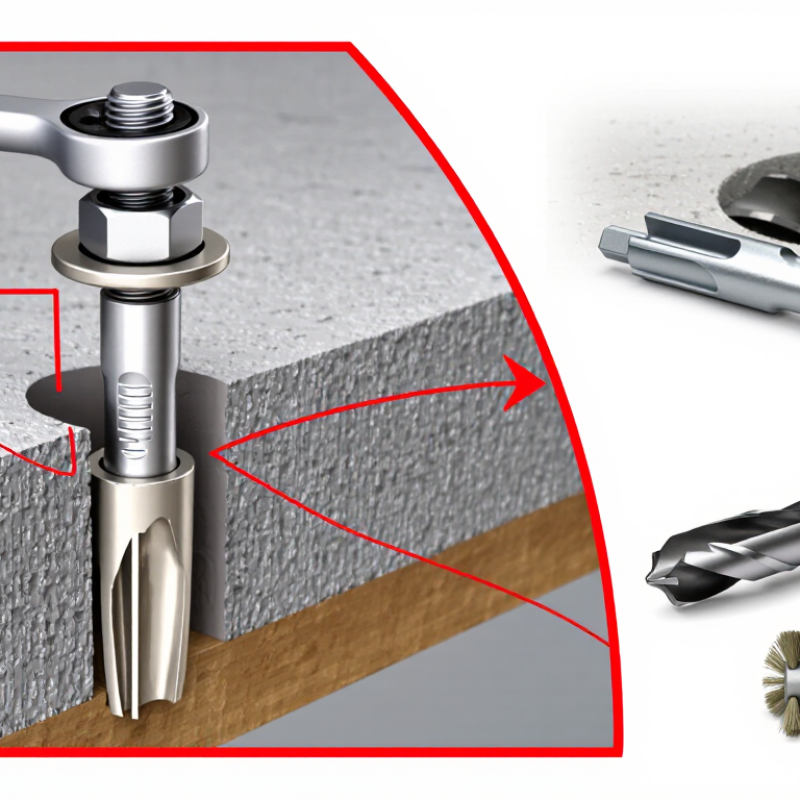
| Product Definition | A wedge anchor is a mechanical expansion anchor consisting of a threaded stud, expansion clip, nut, and washer. | Select a wedge anchor only when the base material and the required load conditions are suitable for mechanical expansion anchoring. |
| Working Principle | Tightening the nut pulls the tapered stud into the expansion clip. The clip presses against the sides of the drilled hole and creates friction and mechanical interlock. | Correct installation torque is essential. Under-tightening may reduce holding power, while over-tightening can damage the anchor or base material. |
| Approved Base Materials | Wedge anchors are generally designed for solid concrete, including normal-weight and lightweight concrete, subject to the specific anchor approval or manufacturer’s technical data. | They are not normally intended for hollow block, brick, drywall, wood, asphalt, or unreinforced weak substrates unless a suitable product is specifically approved for that material. |
| Concrete Condition | Many wedge anchors are available for cracked and non-cracked concrete, but the allowable design loads can differ significantly. | For structural or safety-related fastening, verify whether the anchor is qualified for cracked concrete and follow the applicable design standard. |
| Typical Load Directions | Wedge anchors can resist tension, shear, and combined tension-and-shear loads when properly selected and installed. | Check edge distance, anchor spacing, concrete thickness, and load direction because these factors can control the design capacity. |
| Common Anchor Diameters | Common nominal diameters include approximately 1/4 in, 3/8 in, 1/2 in, 5/8 in, 3/4 in, and 1 in. Metric sizes are also widely available. | The diameter should be selected from engineering requirements, fixture-hole size, required capacity, and the anchor’s published technical data. |
| Drill Hole Diameter | For many wedge-anchor systems, the required drill-bit diameter is the same as the anchor’s nominal diameter. | Always confirm the required hole diameter in the installation instructions because product designs and regional standards may vary. |
| Hole Depth | The drilled hole must be deeper than the specified embedment so that drilling dust and debris do not prevent full installation. | A common practice is to drill slightly deeper than the minimum required depth, while avoiding reinforcement, utilities, or excessive loss of concrete section. |
| Effective Embedment | Effective embedment is the depth over which the anchor transfers load to the concrete. Greater embedment can improve capacity, but only within the limits of the anchor design and concrete thickness. | Do not assume that maximum embedment always provides the highest allowable load. Use the tested or engineered embedment range for the selected anchor. |
| Installation Method | The usual process is: drill a hole, clean the hole, insert the anchor through the fixture, install the washer and nut, and tighten to the specified torque. | Hole cleaning is important. Dust or loose material can interfere with anchor seating and reduce performance. |
| Hole-Cleaning Procedure | Depending on the product instructions, cleaning may involve brushing and blowing or vacuuming the hole to remove drilling dust. | Follow the specified cleaning sequence and tools, especially for anchors used in structural, overhead, or life-safety applications. |
| Typical Applications | Common uses include fastening base plates, handrails, guardrails, steel framing, equipment supports, cable trays, pipe supports, shelving, and nonstructural fixtures to concrete. | Confirm that the application does not require a different anchor type, such as a chemical anchor, undercut anchor, sleeve anchor, or anchor designed for hollow masonry. |
| Edge Distance | Installing too close to a concrete edge can cause splitting, breakout, or reduced load capacity. | Use the minimum edge distance specified for the anchor and design condition. Larger edge distances are generally beneficial when space permits. |
| Anchor Spacing | Closely spaced anchors can create overlapping stress zones in the concrete and may have reduced group capacity. | Check the required minimum spacing and any group-action reduction factors in the technical documentation or engineering design. |
| Concrete Thickness | The concrete must be thick enough to provide the required embedment and maintain adequate resistance against breakout and splitting. | Do not install an anchor when the required embedment would leave insufficient concrete below the anchor or risk striking reinforcement. |
| Corrosion Resistance | Available finishes commonly include zinc-plated steel, mechanically galvanized or hot-dip galvanized steel, and stainless steel. | Choose the finish according to indoor, outdoor, wet, coastal, chemical, or otherwise corrosive exposure. Coating choice does not replace a corrosion assessment. |
| Load Capacity | Capacity depends on anchor diameter, embedment, concrete strength, cracked or non-cracked concrete, edge distance, spacing, installation quality, and load direction. | Do not use a generic load value. Use the published allowable or design-strength data for the exact anchor, concrete condition, and installation configuration. |
| Advantages | Wedge anchors provide immediate load-bearing capability after installation, use standard drilling equipment, and are suitable for many permanent concrete fixtures. | They are especially useful when immediate fastening is required and the concrete is strong enough to support expansion forces. |
| Limitations | They require a solid concrete substrate and can be affected by inadequate hole cleaning, insufficient embedment, edge proximity, improper torque, and unsuitable concrete conditions. | Consider an alternative anchoring method when expansion pressure is undesirable or when the substrate is hollow, weak, thin, or heavily cracked. |
| Inspection Points | Inspect anchor diameter, material or finish, hole diameter, embedment, spacing, edge distance, washer and nut placement, and installation torque. | For critical work, document installation details and use calibrated torque equipment where the instructions require torque-controlled installation. |
| Safety Reminder | For structural, overhead, seismic, fire-protection, guardrail, or life-safety applications, the anchor should be selected and verified by a qualified professional using the applicable building code, approval, and engineering data. |

.svg)