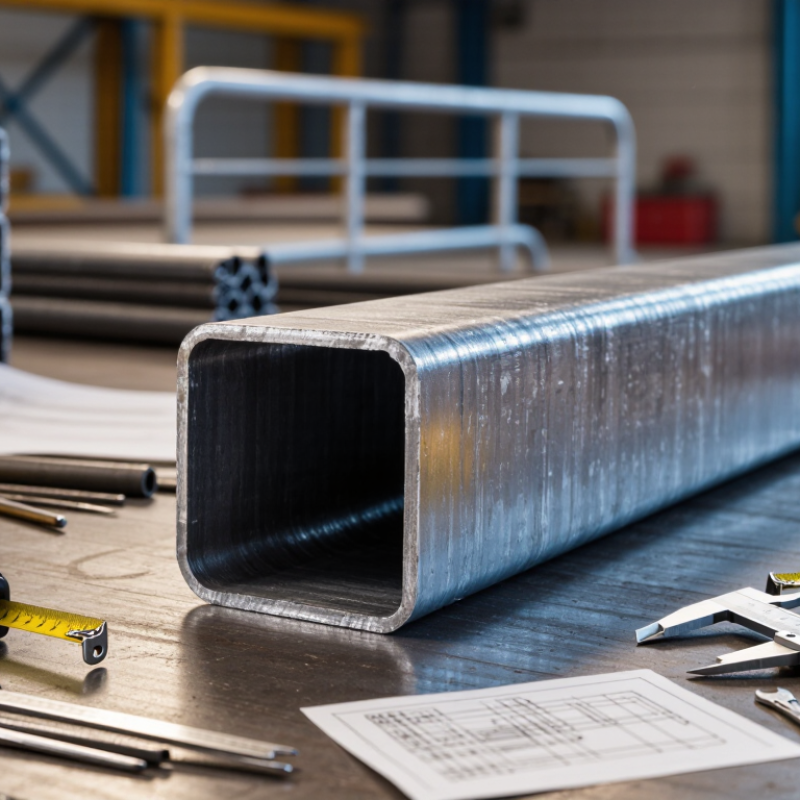
| Definition | An iron square pipe is a hollow structural section with a square cross-section and four generally flat sides. In commercial construction, the term commonly refers to square hollow sections made from carbon steel or mild steel rather than pure iron. | Its hollow shape provides useful strength and stiffness while using less material than a solid bar of similar outside dimensions. |
| Common Manufacturing Process | Many square pipes are produced by forming steel strip or sheet into a round tube and then shaping it into a square profile. The longitudinal seam is typically welded, followed by sizing and cutting to length. | Manufacturing affects dimensional accuracy, weld quality, surface condition, and suitability for structural or fabrication work. |
| Typical Cross-Section | Square outside profiles are available in many sizes, with wall thickness selected according to load, span, connection method, and fabrication requirements. | A square profile offers similar bending resistance about its two principal axes, making it useful when loads may act in different directions. |
| Primary Structural Function | It can serve as a column, post, brace, frame member, support, rail, or other load-carrying component when the selected section is properly designed. | Designers can use it for compression, bending, or combined loading, subject to engineering calculations and applicable building codes. |
| Construction Uses | Typical applications include light structural frames, partitions, gates, handrails, guardrails, roof-support components, equipment stands, and temporary supports. | Its straight geometry simplifies layout, alignment, cutting, welding, and connection to plates or brackets. |
| Furniture and Interior Fabrication | Square pipe is frequently used for table frames, shelving supports, chairs, bed frames, display structures, and decorative metalwork. | The regular profile creates clean visual lines and provides a stable base for welded, bolted, or mechanically fastened assemblies. |
| Industrial and Equipment Applications | It may be used for machine guards, conveyor supports, workbenches, storage racks, agricultural frames, carts, and protective enclosures. | Its combination of rigidity, availability, and fabrication flexibility supports customized industrial assemblies. |
| Load-Bearing Capability | Capacity depends on outside dimensions, wall thickness, steel grade, unsupported length, end restraint, connection details, loading direction, and installation quality. | Outside dimensions alone are not enough to determine safe capacity; structural members should be checked for yielding, buckling, deflection, and connection strength. |
| Strength-to-Weight Benefit | The closed hollow section places material away from the center of the profile, which can improve bending efficiency compared with some solid sections of similar weight. | This can reduce material use and make components easier to handle, while still providing useful stiffness. |
| Fabrication Features | It can generally be cut, drilled, welded, bolted, punched, and finished with suitable tools and procedures. Corners may be radiused rather than perfectly sharp. | Fabricators can create frames and assemblies with relatively few components and straightforward joints. |
| Surface Finishes | Common finishes include untreated mill finish, painted or powder-coated surfaces, and zinc-based protective coatings. The appropriate finish depends on exposure and maintenance needs. | Protective coatings help reduce corrosion, especially in humid, outdoor, or chemically aggressive environments. |
| Corrosion Considerations | Unprotected carbon steel can rust when exposed to moisture, oxygen, salts, or corrosive chemicals. Cut edges, welds, and damaged coating areas require particular attention. | Designers should specify corrosion protection, drainage, inspection, and maintenance where long service life is required. |
| Connection Methods | Typical connections include fillet welds, bolted end plates, gusset plates, brackets, clamps, and internally reinforced or sleeved joints. | Connection design is essential because the joint may govern the strength, stability, and durability of the complete assembly. |
| Advantages | Key advantages include a balanced square profile, good rigidity, efficient use of material, simple fabrication, clean appearance, and broad availability in structural steel markets. | These characteristics make it suitable for both functional structures and visible architectural or furniture applications. |
| Limitations | Potential limitations include internal corrosion that may be difficult to inspect, local buckling in thin walls, distortion during welding, and reduced performance if improperly supported or connected. | Proper wall thickness, detailing, welding practice, drainage, and inspection are needed to avoid premature failure. |
| Selection Criteria | Selection should consider required strength and stiffness, outside size, wall thickness, steel grade, member length, loading, environmental exposure, connection type, fabrication method, and applicable standards. | A qualified engineer or fabricator should verify the section for the intended service conditions rather than selecting it by appearance alone. |
| Best-Suited Environments | It is well suited to indoor construction, workshops, furniture production, general fabrication, and protected outdoor structures when an appropriate finish is applied. | For marine, coastal, buried, or highly corrosive service, additional material and coating requirements may be necessary. |

.svg)