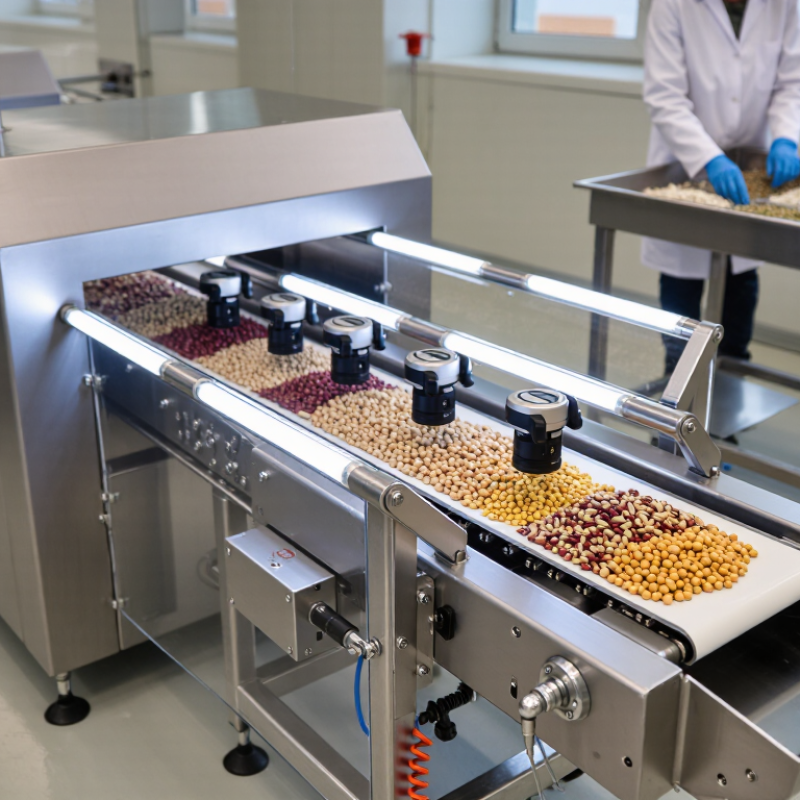
| Feed and singulation | Separates beans into a controlled, visible flow before inspection. | Not a defect-detection stage; it prevents overlapping beans from hiding defects. | Vibratory feeders, chutes, or belts distribute individual beans across the inspection zone. | Accurate singulation improves detection because cameras need a clear view of each bean. |
| RGB cameras | Capture visible red, green, and blue color information together with surface shape and appearance. | Dark beans, pale or discolored beans, mold-like surface marks, insect damage, stains, broken pieces, and foreign material with visible color contrast. | Each bean is compared with programmed color, brightness, size, and shape thresholds or classification models. | Performance depends on stable lighting, clean optics, and sufficient contrast between acceptable and defective material. |
| NIR cameras | Measure reflected near-infrared energy, generally beyond the visible color range. | Some moisture-related differences, internal or surface composition differences, organic contamination, and defects that have weak visible-color contrast. | Materials reflect and absorb near-infrared wavelengths differently; the system classifies beans using their spectral response. | NIR does not automatically identify every internal defect. Calibration must match bean variety, moisture, lighting, and product condition. |
| Combined RGB and NIR inspection | Combines visible appearance data with spectral information. | Mixed defects, subtle discoloration, visually similar foreign material, and quality differences that are difficult to separate with one sensor alone. | Software fuses multiple image channels and applies rejection rules or trained classification models. | Using multiple sensor types can reduce false accepts, but it requires more calibration and consistent operating conditions. |
| LED illumination | Provides stable, controlled lighting for image capture. | Supports detection of color variation, surface spots, cracks, and shape irregularities. | Uniform light minimizes shadows and changes caused by ambient illumination. | Light intensity, color temperature, reflections, and protective windows should be checked during routine cleaning and maintenance. |
| Image-processing software | Analyzes color, spectral response, geometry, position, and defect severity. | Classifies beans as acceptable, defective, or foreign material according to configured quality limits. | Algorithms identify pixels or object features that fall outside the accepted product profile. | Thresholds should be validated with representative good product and known defect samples to balance removal and product loss. |
| Air ejectors | Remove selected beans or particles from the product stream. | Defective beans, stones, glass fragments, plant debris, damaged pieces, and other classified rejects. | Fast solenoid valves release short bursts of compressed air precisely when a target reaches the ejection point. | Correct timing, air pressure, nozzle alignment, and clean compressed air are essential for accurate removal. |
| Reject collection | Separates ejected material from accepted beans for inspection or disposal. | Aggregated defective beans and foreign material removed during sorting. | A separate reject chute or collection bin receives the air-ejected particles. | Rejects should be reviewed periodically to verify that the sorter is removing the intended material without excessive good product. |
| Detection sensitivity | Defines how readily the system responds to a suspected defect. | Small color deviations, small foreign particles, or low-contrast defects. | Higher sensitivity widens the rejection criteria; lower sensitivity accepts a broader range of appearance. | Increasing sensitivity can improve defect removal but may also increase false rejects and usable-product loss. |
| False accept | A defective bean or foreign particle passes into the accepted product stream. | Subtle stains, partially hidden damage, low-contrast defects, or overlapped beans. | Occurs when the defect is outside the camera view, below the detection threshold, or similar to acceptable product. | Reduced by effective singulation, suitable sensor selection, representative calibration samples, and regular verification. |
| False reject | An acceptable bean is incorrectly removed from the product stream. | Natural color variation, harmless surface marks, or beans near the programmed quality limit. | Occurs when an acceptable feature is interpreted as a defect. | Controlled by refining product recipes, reviewing reject samples, and setting commercially appropriate quality limits. |
| Compressed-air requirements | Provide the force needed to redirect selected material. | Applies to every reject category handled by the air-ejection system. | Clean, dry, filtered air supports repeatable valve and nozzle performance. | Pressure and flow must be sufficient for the product speed and particle size; moisture or oil can damage equipment and affect reliability. |
| Routine verification | Checks whether detection and ejection remain within the intended quality limits. | All configured defect categories and foreign-material classes. | Known test samples or controlled checks are passed through the machine and the results are recorded. | Verification should be performed after cleaning, recipe changes, maintenance, or changes in bean variety and moisture. |

.svg)