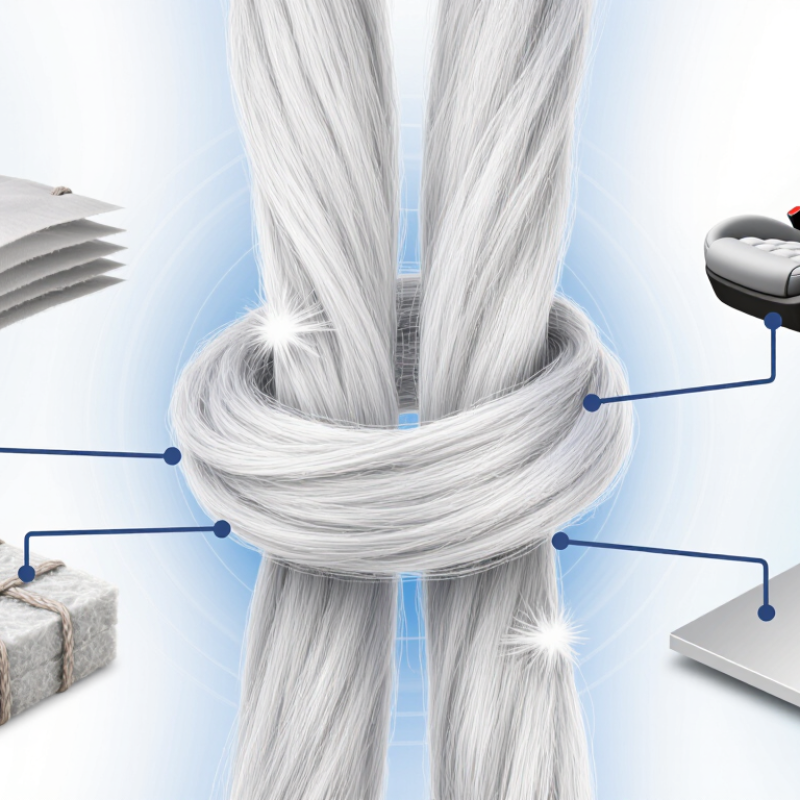
| Basic Definition | A polyester staple fiber designed to soften or melt at a lower temperature than standard polyester fiber. | It is commonly used as a thermally activatable binder fiber for bonding nonwovens, insulation, padding, filtration media, and molded fiber products. |
| Common Fiber Structure | Often bicomponent, with a lower-melting polyester sheath surrounding a higher-melting polyester core. | The sheath flows during heating and bonds adjacent fibers, while the core helps retain dimensional stability and mechanical integrity. |
| Low-Melting Component | Approximately 110–180°C, depending on polymer chemistry and product design. | The activation temperature must be selected according to the end-use substrate, production equipment, and required bonding strength. |
| Standard Polyester Reference | Polyester made from polyethylene terephthalate generally melts at approximately 250–260°C. | The lower activation temperature of low-melt polyester can reduce thermal damage to heat-sensitive fibers and substrates. |
| Softening Behavior | The low-melting component softens first, becomes viscous, and forms bonding points before the core melts. | Controlled softening allows thermal bonding without fully liquefying the entire fiber structure. |
| Recommended Processing Window | Typically set above the sheath activation temperature and below the melting temperature of the structural component. | Actual settings depend on dwell time, airflow, web thickness, fiber blend, oven type, and bonding requirements. A temperature trial is recommended for each formulation. |
| Fiber Length | Common commercial staple lengths include approximately 3–15 mm, with longer lengths also available for selected applications. | Shorter fibers can improve blend uniformity, while longer fibers may contribute to web integrity and reinforcement. |
| Linear Density | Often approximately 1.5–15 dtex, depending on the intended application. | Finer fibers generally provide a softer hand and larger bonding surface area; coarser fibers can improve bulk and processing stability. |
| Bonding Mechanism | Thermal fusion at fiber intersections, usually through the softened outer component. | Bonding can be achieved in ovens, through hot air, or by other controlled thermal processes without adding a liquid adhesive. |
| Bonding Strength | Application-dependent; affected by fiber percentage, temperature, pressure, residence time, and cooling conditions. | Higher binder content and stronger thermal activation can increase bonding, but excessive heat may reduce loft, flexibility, or breathability. |
| Thermal Stability | The structural component remains stable above the activation range of the low-melting component. | This supports shape retention after cooling and helps the bonded assembly withstand normal service temperatures. |
| Shrinkage | Varies by polymer type, draw ratio, heat history, and processing conditions; it should be measured under the intended test method. | Heat-setting and controlled processing can reduce unwanted dimensional change in the finished product. |
| Moisture Absorption | Low moisture regain, typical of polyester fibers. | Low moisture absorption supports dimensional stability and relatively consistent performance in humid environments, although surface contamination and finishing treatments still matter. |
| Chemical Resistance | Generally resistant to many weak acids and common solvents, but vulnerable to strong alkalis and certain aggressive chemicals. | Chemical compatibility should be confirmed for applications involving alkaline washing, solvents, coatings, or chemical finishing. |
| Handle and Flexibility | Can produce soft, resilient, and flexible bonded structures when the thermal cycle is properly controlled. | Overheating or excessive binder content can create stiff bonding points and reduce drape or compressibility. |
| Typical Applications | Nonwoven fabrics, automotive interiors, furniture padding, mattresses, insulation, filtration media, acoustic products, and molded fiber components. | The fiber is especially useful where solvent-free bonding, low-temperature processing, or improved dimensional stability is required. |
| Key Advantages | Lower bonding temperature, good blendability, low moisture uptake, lightweight construction, and recyclable polyester-based options. | These advantages can simplify processing and help preserve the properties of heat-sensitive companion fibers. |
| Main Processing Risks | Insufficient activation, uneven heating, over-melting, migration of molten polymer, and loss of loft. | Consistent web formation, accurate temperature control, suitable airflow, and adequate cooling are important for uniform product quality. |
| Quality-Control Tests | Melting or softening range, linear density, staple length, tensile properties, shrinkage, moisture content, thermal bonding strength, and appearance. | Testing should be performed using defined laboratory methods and conditions that reflect the intended manufacturing process. |

.svg)