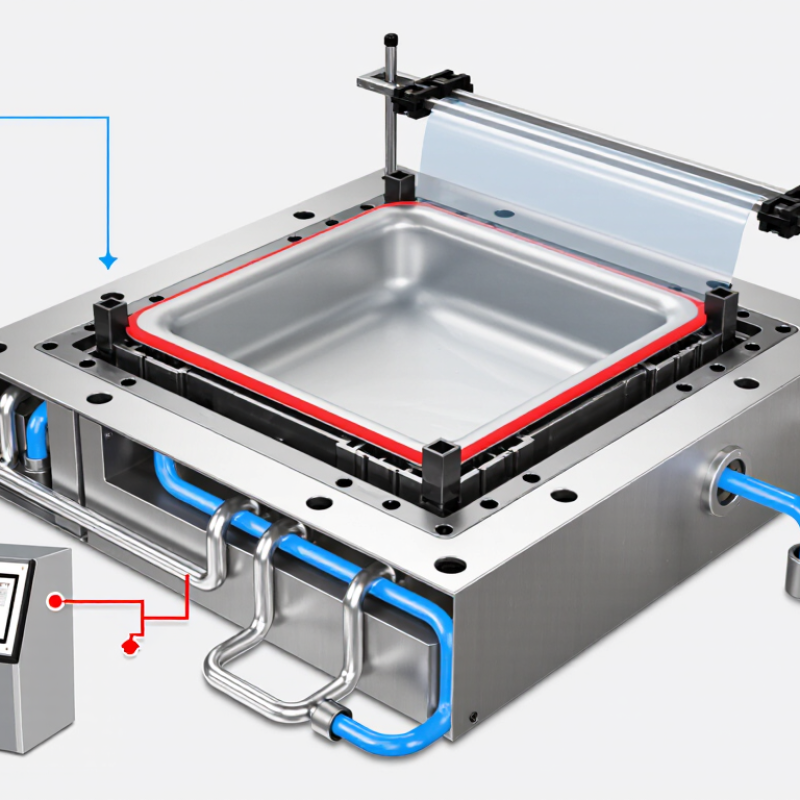
| Thermoforming Mold Assembly | A coordinated set of mold components used to shape a heated thermoplastic sheet or web into a defined three-dimensional form. | It provides the forming surface and supports the controlled creation of repeatable parts such as trays, containers, panels, and protective packaging. | The assembly must match the forming method, part geometry, material, and required production volume. |
| Mold or Tooling Surface | The male or female surface that determines the external or internal shape of the formed part. | It transfers the intended dimensions, contours, texture, and draft angles to the softened plastic sheet. | Smooth surfaces generally support easier release and more consistent appearance. |
| Base Plate | A rigid structural plate to which the mold and related components are attached. | It stabilizes the tooling, maintains alignment, and provides a connection between the mold and the forming machine. | Adequate stiffness helps reduce deflection during vacuum, pressure, or mechanical forming. |
| Vacuum Channels | Small passages or drilled openings that connect the mold surface to a vacuum system. | They remove air between the heated sheet and the mold so atmospheric pressure can draw the material against the forming surface. | Channel placement should support uniform material contact without leaving unwanted marks on the part. |
| Pressure-Air System | Air passages and fittings used to apply compressed air during pressure-assisted thermoforming. | It supplements vacuum forming by applying positive pressure, helping reproduce finer details and improve dimensional definition. | Pressure requirements depend on the material, thickness, mold design, and machine capability. |
| Cooling Channels | Internal passages through which water or another cooling medium circulates within the mold or mold plate. | They remove heat from the formed sheet, shorten cycle time, and help the part retain its shape during demolding. | Balanced cooling is important for reducing warpage, uneven shrinkage, and cycle-to-cycle variation. |
| Temperature-Control Components | Sensors, heaters, valves, and control connections used to monitor or regulate mold temperature. | They help maintain a stable thermal condition for consistent forming, surface quality, and dimensional accuracy. | The suitable temperature depends on the selected thermoplastic and the process window established during trials. |
| Parting Line | The planned boundary where mold sections, inserts, or trimming features meet. | It enables practical mold construction, part release, and integration with downstream trimming operations. | Its location should minimize visible marks and avoid locking the formed part onto the mold. |
| Draft Angle | A slight taper applied to vertical or near-vertical walls of the mold and finished part. | It allows the formed component to release from the mold with less friction and lower risk of deformation. | Deeper features and textured surfaces generally require more draft than shallow, smooth features. |
| Vent and Release Features | Small openings, ejector features, or air-release provisions incorporated into the mold design. | They help evacuate trapped air and support clean separation of the cooled part from the mold. | These features should be positioned to avoid cosmetic defects and unwanted impressions. |
| Alignment and Clamping Hardware | Pins, guides, fasteners, clamps, and locating features that keep assembly components in their intended positions. | They maintain repeatable registration between the mold, base, pressure box, cutting tools, and machine platen. | Secure alignment is essential when several forming or trimming stations operate in sequence. |
| Common Mold Materials | Tooling may be manufactured from aluminum, steel, epoxy-based materials, composite materials, or other suitable engineering materials. | Material selection affects thermal conductivity, durability, machinability, surface finish, weight, and tooling cost. | Aluminum is often selected for efficient heat transfer and machining, while harder materials may be used where extended wear resistance is required. |
| Forming Methods | Thermoforming mold assemblies may be used with vacuum forming, pressure forming, twin-sheet forming, or mechanical plug-assist processes. | The method determines how the heated plastic is moved against the mold and what supporting components are required. | Vacuum forming uses negative pressure; pressure forming adds compressed air; plug assist uses a mechanical pre-stretching element. |
| Typical Thermoplastics | Materials commonly processed by thermoforming include ABS, PET, PVC, PS, PP, PE, and polycarbonate grades. | The selected plastic determines heating behavior, forming temperature range, stiffness, shrinkage, appearance, and end-use performance. | Processing parameters must be established for the specific resin grade, sheet thickness, and part design. |
| Quality Objectives | The measurable performance targets applied to the finished formed part and the mold assembly. | Typical objectives include consistent wall thickness, accurate dimensions, reliable release, acceptable surface finish, and stable cycle time. | Mold design, sheet heating, vacuum or pressure distribution, cooling, and trimming must work together to achieve consistent results. |

.svg)