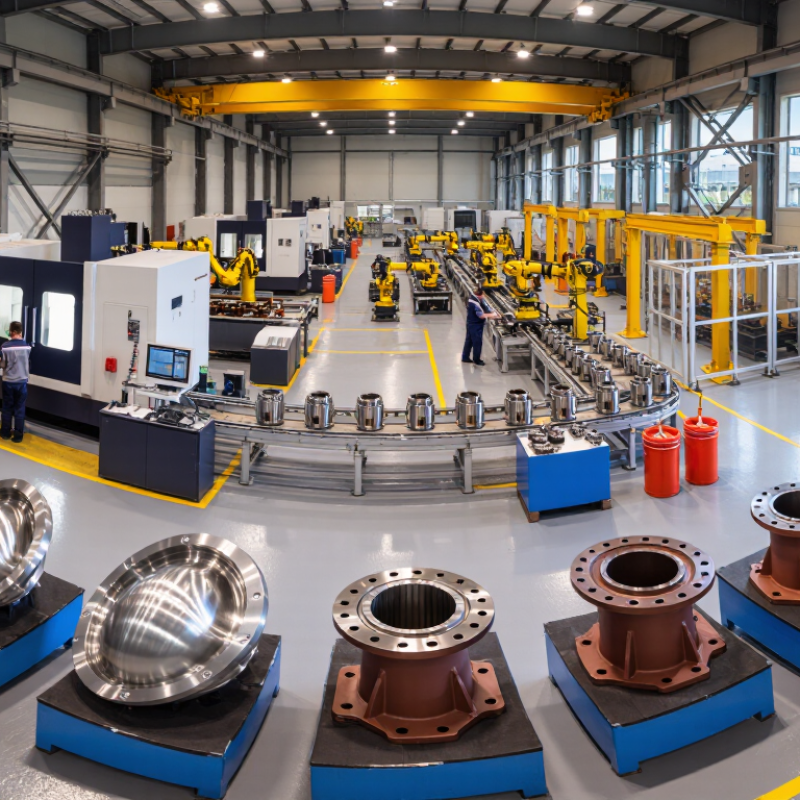
| Impeller | Transfers mechanical energy from the shaft to the fluid and generates flow and pressure. | Stainless steel, ductile iron, cast iron, bronze, engineered polymers. | Investment casting, sand casting, precision machining, or injection molding for selected polymers. | Its diameter, vane geometry, balance, and surface condition directly affect pump head, efficiency, vibration, and cavitation behavior. | Dynamic balance, dimensional accuracy, vane erosion, corrosion, cracks, and casting defects. |
| Pump Casing | Contains the fluid and converts velocity energy into pressure in centrifugal pump designs. | Cast iron, ductile iron, carbon steel, stainless steel, duplex stainless steel. | Sand casting, investment casting, welding, heat treatment, and CNC machining. | A correctly designed casing supports pressure containment, hydraulic efficiency, alignment, and safe operation. | Pressure testing, wall thickness, flange dimensions, sealing faces, porosity, and corrosion allowance. |
| Pump Shaft | Transmits torque from the driver to the impeller and maintains rotating-part alignment. | Carbon steel, alloy steel, 410 stainless steel, 17-4 PH stainless steel, duplex stainless steel. | Forging or bar stock machining, heat treatment, grinding, and polishing of sealing areas. | Shaft strength and runout influence vibration, seal life, bearing loading, and resistance to fatigue failure. | Straightness, runout, keyway dimensions, hardness, surface finish, and corrosion or fatigue damage. |
| Mechanical Seal | Prevents process fluid from leaking along the rotating shaft or sleeve. | Carbon, silicon carbide, tungsten carbide, stainless steel, elastomers such as EPDM or FKM. | Precision lapping, grinding, molding, machining, and controlled assembly. | Seal compatibility with pressure, temperature, speed, and fluid chemistry is essential for safe, low-emission operation. | Face flatness, surface finish, elastomer compatibility, spring condition, leakage testing, and correct installation dimensions. |
| Wear Ring | Maintains a controlled clearance between the impeller and casing to limit internal recirculation. | Bronze, stainless steel, hardened steel, nickel-based alloys, and selected polymers. | CNC turning, boring, grinding, and sometimes surface hardening. | Excessive clearance reduces volumetric efficiency and can increase operating cost and hydraulic instability. | Inside and outside diameter, concentricity, surface wear, scoring, and installed clearance. |
| Bearing | Supports the shaft and manages radial and axial loads during operation. | Chrome steel, stainless steel, ceramic rolling elements, bronze, or composite bearing materials. | Precision grinding, heat treatment, superfinishing, and controlled assembly. | Bearing condition affects vibration, temperature, alignment, energy consumption, and overall pump reliability. | Noise, temperature, lubrication, vibration, clearance, raceway damage, and contamination. |
| Gasket and O-Ring | Seals static joints between casing sections, flanges, covers, and other stationary interfaces. | EPDM, FKM, NBR, PTFE, graphite, compressed fiber, and spiral-wound metallic materials. | Molding, die cutting, skiving, winding, and precision profile forming. | Correct material and compression prevent leakage, chemical attack, air ingress, and loss of system pressure. | Size, hardness, compression, chemical compatibility, surface damage, and signs of extrusion or swelling. |
| Shaft Sleeve | Protects the shaft from wear and corrosion beneath the mechanical seal or packing. | Stainless steel, hardened stainless steel, nickel alloys, and ceramic-coated materials. | Tube or bar machining, grinding, polishing, and optional coating or hardening. | A smooth, durable sleeve surface helps protect the shaft and supports consistent sealing performance. | Surface finish, wall thickness, concentricity, corrosion, grooves, and fit with the seal components. |
| Diffuser or Guide Vane | Guides fluid flow and converts velocity into pressure, particularly in multistage or specialty pumps. | Cast iron, stainless steel, engineered polymers, and wear-resistant alloys. | Casting, injection molding, CNC machining, and finishing of hydraulic passages. | Accurate hydraulic passages improve stage efficiency, pressure generation, and stable flow distribution. | Vane profile, passage dimensions, erosion, fouling, cracks, and alignment within the pump stage. |

.svg)