| Material Designation | AISI 304; UNS S30400; EN 1.4301 | These designations identify the same general austenitic stainless-steel grade under commonly used American and European systems. |
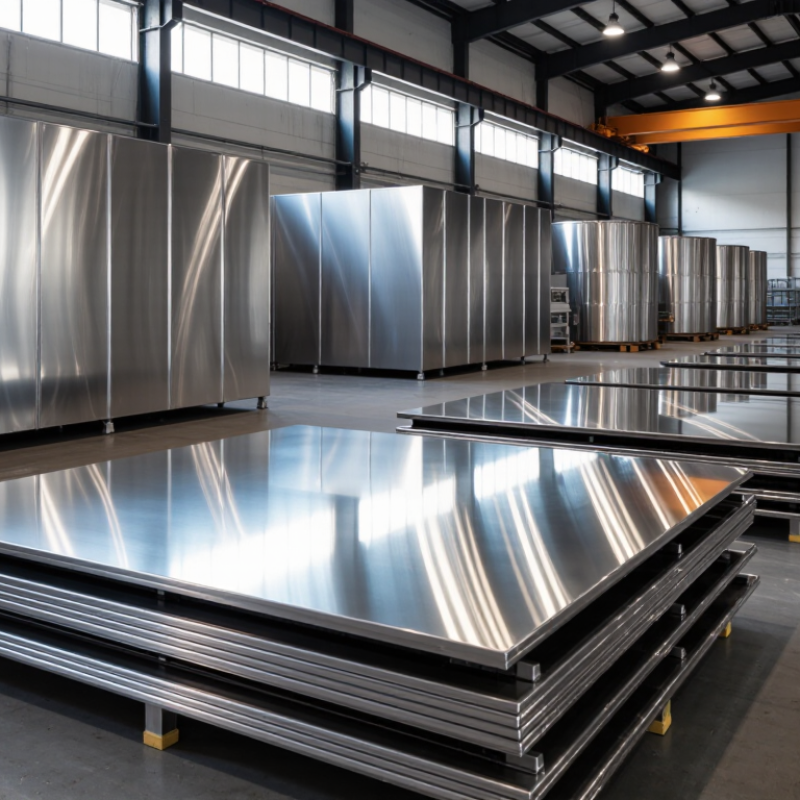
| Product Form | Flat-rolled stainless-steel plate | It is supplied as a flat product and can be cut, formed, welded, machined, or fabricated for structural and process equipment applications. |
| Primary Alloy Family | Austenitic stainless steel | The austenitic structure provides good ductility, weldability, and toughness over a broad range of service conditions. |
| Chromium Content | 18.00–20.00 wt.% | Chromium forms a thin, self-healing passive oxide layer that provides the material's basic corrosion resistance. |
| Nickel Content | 8.00–10.50 wt.% | Nickel stabilizes the austenitic structure and supports ductility, toughness, and corrosion resistance. |
| Carbon Content | Maximum 0.07 wt.% | The controlled carbon level supports weldability. For more demanding welded construction, 304L may be selected because it has a lower carbon limit. |
| Other Composition Limits | Mn ≤ 2.00%; Si ≤ 1.00%; P ≤ 0.045%; S ≤ 0.030%; N ≤ 0.10% | Actual limits depend on the applicable product specification and material certificate. |
| Minimum Tensile Strength | 515 MPa approximately 75 ksi | Typical minimum requirement for annealed plate under ASTM A240/A240M; the governing standard should be confirmed for each project. |
| Minimum Yield Strength | 205 MPa approximately 30 ksi | This value is commonly specified at 0.2% offset for annealed 304 plate. |
| Minimum Elongation | 40% in 50 mm typical ASTM requirement | High elongation supports forming and fabrication, although actual results vary with product thickness and testing direction. |
| Density | Approximately 8.00 g/cm³ | This value is useful for estimating shipping weight, structural loads, and material quantities. |
| Melting Range | Approximately 1,400–1,450 °C | The range is relevant to welding, heat treatment, thermal processing, and high-temperature design calculations. |
| Magnetic Behavior | Generally non-magnetic when annealed | Cold working or forming can induce some magnetism. Magnetic response should not be used as the sole method of grade identification. |
| Corrosion Resistance | Good resistance in many atmospheric and mildly corrosive environments | Performance depends on temperature, chloride concentration, surface condition, crevices, deposits, and cleaning practices. |
| Chloride Limitation | Not the preferred choice for severe chloride exposure | Pitting and crevice corrosion can occur in seawater, concentrated chlorides, and warm chloride-bearing environments; a molybdenum-bearing grade may be more suitable. |
| Weldability | Excellent for common fusion-welding processes | Shielded metal arc, gas metal arc, gas tungsten arc, and resistance welding are commonly used. Heat tint should be removed and the surface restored when corrosion performance matters. |
| Formability | Very good, with work-hardening tendency | The alloy can be bent, rolled, and deep-drawn, but springback and increased hardness after cold work should be considered in tooling design. |
| Machinability | Good with appropriate stainless-steel tooling and feeds | Work hardening makes sharp tools, controlled cutting conditions, and sufficient cooling important during machining. |
| Common Surface Finishes | 2B, No. 1, brushed, polished, and custom-finished surfaces | The required finish should be specified according to appearance, cleanability, friction, reflectivity, and corrosion-service needs. |
| Typical Applications | Food-processing equipment, kitchen equipment, tanks, piping components, architectural panels, pharmaceutical equipment, and general fabrication | The broad application range results from the combination of corrosion resistance, strength, formability, weldability, and global availability. |
| Common Product Standard | ASTM A240/A240M for stainless-steel plate, sheet, and strip for pressure vessels and general applications | Other projects may require EN, JIS, or other national standards. Chemical, mechanical, dimensional, inspection, and documentation requirements should be stated in the purchase specification. |
| Inspection Documentation | Material test certificate, heat number, chemical analysis, mechanical test results, dimensions, and surface condition | Traceability requirements vary by project. Certificates should correspond to the supplied heat and applicable standard. |
| Key Selection Advantage | Balanced performance and broad international specification coverage | 304 is often selected when a project needs a widely recognized stainless grade with reliable fabrication performance and general-purpose corrosion resistance. |
| Important Design Caution | Grade selection must match the actual service environment | Temperature, chlorides, acids, weld condition, stress, surface finish, cleaning chemicals, and regulatory requirements should be reviewed before final selection. |

.svg)