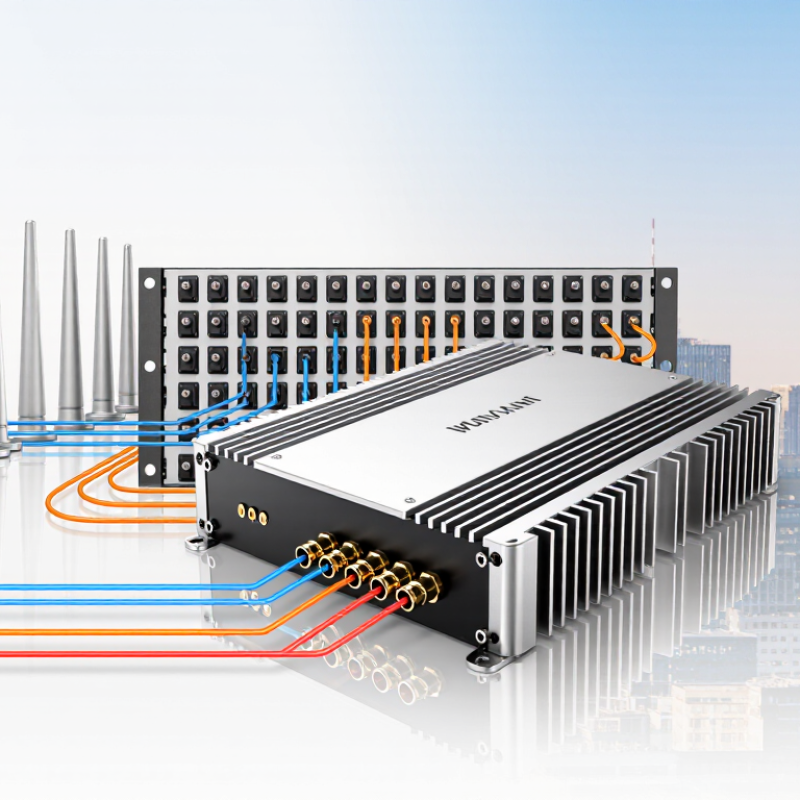
| Definition | A millimeter-wave (mmWave) power amplifier is an RF circuit that increases the power of a signal in the millimeter-wave frequency range before it is sent to an antenna. The conventional mmWave range is approximately 30–300 GHz. | It provides the transmit power needed to drive an antenna or antenna array in a high-frequency wireless system. |
| Short wavelength | Wavelength is inversely proportional to frequency. Across 30–300 GHz, the free-space wavelength is approximately 10–1 mm. | Short wavelengths allow many antenna elements to fit into a relatively compact area, supporting directional antenna arrays and beamforming. |
| Bandwidth potential | Large contiguous frequency allocations are available in some mmWave bands, although the bandwidth available depends on the band, region, and application. | Wide channel bandwidth can support high data rates when the radio system, spectrum allocation, and link conditions allow it. |
| Propagation and coverage | At the same distance and with otherwise equal conditions, free-space path loss increases with frequency. mmWave links can also be more sensitive to blockage by objects and to propagation conditions. | A suitable amplifier, antenna gain, careful link design, and beamforming can help meet link-budget requirements; an amplifier alone does not remove propagation loss or blockage. |
| Linearity | Power amplifiers can introduce nonlinear distortion, especially when operated near their output limits. Signals with high peak-to-average power ratios may require output back-off to maintain linearity. | Good linearity helps preserve signal quality and limit unwanted spectral emissions, but operating with more back-off can reduce efficiency. |
| Efficiency and heat | Power-amplifier efficiency depends on frequency, output level, circuit design, and operating conditions. Power not converted into RF output is largely dissipated as heat. | Efficiency and thermal management affect power consumption, cooling requirements, and the achievable transmit duty cycle. |
| Integration considerations | At mmWave frequencies, layout parasitics, interconnects, packaging, impedance matching, and antenna integration can strongly affect performance. | Choosing an amplifier designed for the intended frequency band and system environment helps reduce avoidable losses and integration challenges. |
| Common applications | Examples include mmWave cellular and fixed wireless equipment, point-to-point radio links, automotive radar transmitters, and some imaging and sensing systems. | The required frequency, output power, bandwidth, linearity, and duty cycle vary by application, so component selection should be based on the system requirements. |
| When to choose one | Consider an mmWave power amplifier when a transmitter must operate in a mmWave band and needs a specified RF output level, bandwidth, and signal quality. | Evaluate output power, gain, linearity, efficiency, operating bandwidth, thermal limits, and compatibility with the antenna and RF chain before selection. |

.svg)