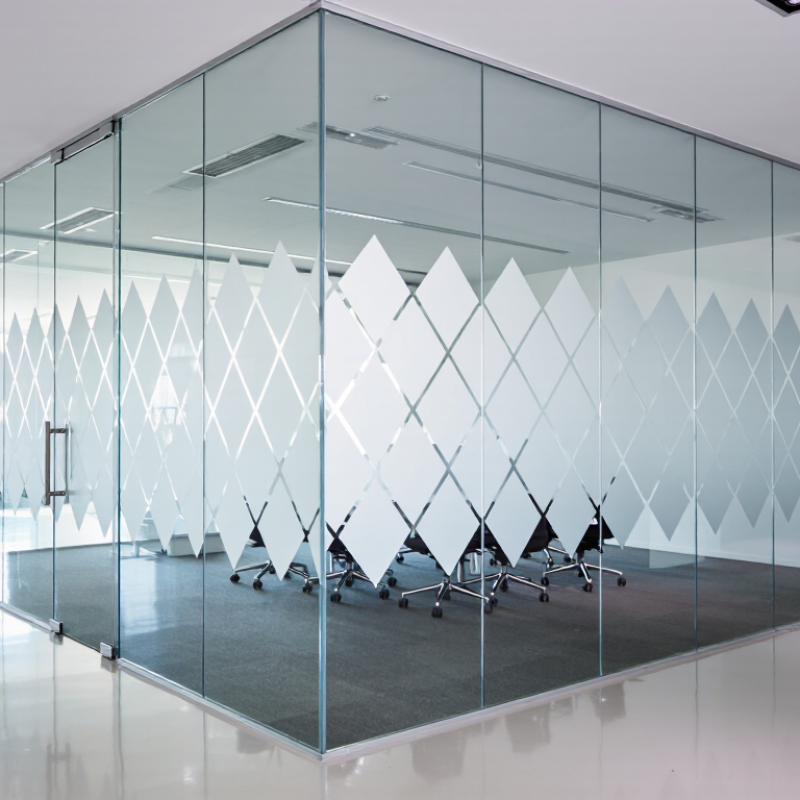
| Frosted or etched-look | Office partitions, meeting rooms, reception areas, and interior glass doors | Diffuses views and daylight; privacy depends on the film’s coverage and pattern | Check opacity, pattern scale, desired privacy, and whether the design should align across multiple panes | Clean the glass thoroughly; apply using the installation method specified for the film and glass type. Allow the recommended curing time before cleaning | Use a soft cloth or clean squeegee with mild soapy water; avoid abrasive pads and sharp tools |
| Printed or patterned | Brand-neutral wayfinding, decorative partitions, storefront accents, and interior feature glass | Varies with printed coverage, color, and pattern density; samples help assess visibility and daylight | Review the artwork at actual viewing distance and confirm dimensions, repeat patterns, and alignment requirements | Confirm the correct face and orientation before application; large designs may require careful panel-by-panel alignment | Clean gently and avoid scraping printed areas; follow the film supplier’s care instructions |
| Gradient or banded | Glass meeting-room walls, doors, and partitions where partial screening is preferred | Leaves some areas clearer while adding screening in selected zones; results depend on band height and spacing | Set band positions with users’ seated and standing sightlines in mind; check applicable building and accessibility requirements | Mark consistent heights across adjoining panes and verify alignment before the film is applied | Use non-abrasive cleaning materials; inspect edges and high-contact areas periodically |
| Colored or opaque decorative | Feature panels, back-of-house screening, and interior design accents | Light transmission ranges from partial to very low depending on the film; opaque finishes block views where covered | Compare physical samples under the space’s lighting and check color appearance against nearby finishes | Confirm whether the product is intended for interior or exterior application and for the specific glass surface | Clean with mild solutions and a soft cloth; avoid solvents unless the film instructions explicitly allow them |
| Custom-cut shapes or logos | Glass doors, reception glazing, and directional or decorative graphics | Privacy and light control depend on the size, spacing, and coverage of the cut elements | Check artwork scale, cut-line accuracy, viewing distance, and local requirements for glass visibility markings | Use a clean, dry surface and a placement guide; inspect spacing and alignment before removing the application liner | Clean carefully around cut edges and check for lifting, especially in areas exposed to frequent touching |
| Decorative film with a safety function | Glazing where a decorative appearance and an added glass-retention function are both required | Appearance and light transmission vary by product; performance depends on the complete tested system | Verify documented performance for the exact film, glass type, installation method, and applicable building requirements | Use a qualified installer where required; decorative film alone should not be assumed to make glazing compliant or impact-resistant | Follow the product-specific cleaning and inspection guidance; replace or repair damaged film as advised |

.svg)