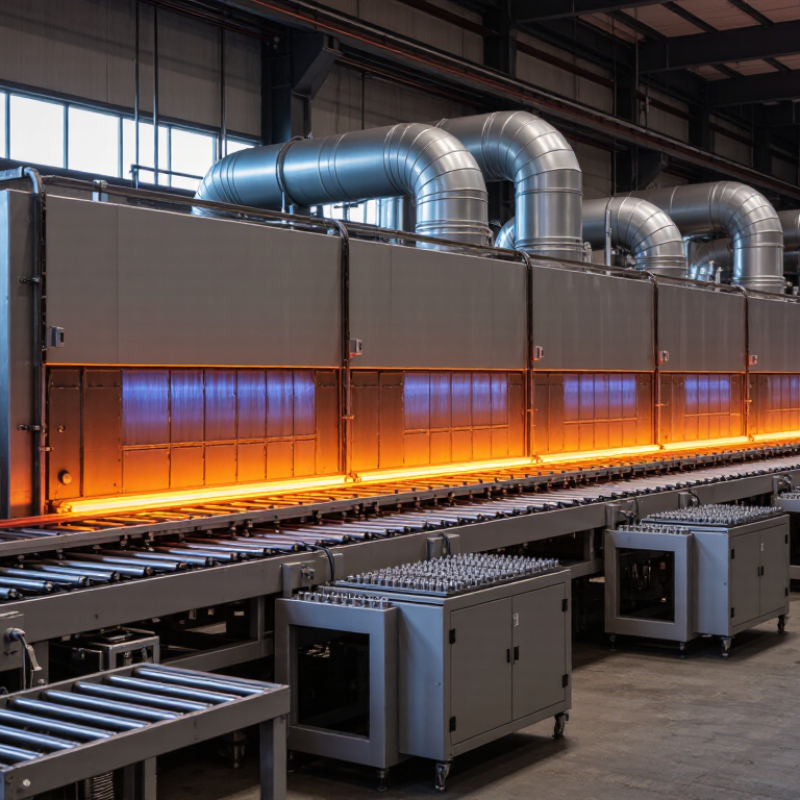
| Loading and Conveying | Continuous belt transport | Parts are placed on a heat-resistant metal or mesh belt and carried through the furnace at a controlled speed. | Supports continuous production and provides more consistent processing than manually loaded batch furnaces. |
| Preheating Zone | Approximately 150–500°C | Material temperature is increased gradually to reduce thermal shock and prepare the workpiece for the heating zone. | Helps minimize distortion, cracking, and uneven temperature distribution, especially in thin or complex parts. |
| Heating Zone | Commonly 500–1,100°C | Electric resistance heaters or gas-fired systems raise the workpiece to the temperature required for stress relief, softening, recrystallization, or process annealing. | The required temperature depends on the alloy and the intended metallurgical result. Steel, copper, aluminum, and stainless steel use different temperature ranges. |
| Soaking Zone | Typically 10–120 minutes | The workpiece remains within a controlled temperature zone long enough for heat to penetrate the section and for the desired metallurgical transformation to occur. | Improves hardness uniformity, ductility, dimensional stability, and repeatability throughout the production batch. |
| Protective Atmosphere | Air, nitrogen, hydrogen-containing, or other controlled atmospheres | Atmosphere control reduces oxidation, scaling, decarburization, or contamination when the material or surface finish requires protection. | Allows the furnace to process parts that need a cleaner surface and reduces post-treatment cleaning or machining. |
| Belt Speed | Often adjustable from approximately 50 mm/min to 5,000 mm/min | A variable-speed drive controls the time each workpiece spends in the preheating, heating, soaking, and cooling zones. | Flexible belt-speed adjustment enables the same furnace to handle different part sizes, materials, production rates, and heat-treatment cycles. |
| Cooling Zone | Controlled cooling from process temperature to handling temperature | Parts are cooled gradually or under a controlled atmosphere after annealing. Forced-air or water-cooled sections may be used where appropriate. | Controlled cooling reduces residual stress and helps achieve the targeted hardness and microstructure without unnecessary distortion. |
| Temperature Uniformity | Common design target: ±5–10°C within the working zone | Thermocouples, independent heating zones, insulation, and airflow management regulate temperature across the furnace chamber. | More uniform temperatures improve part-to-part consistency and reduce the risk of soft spots, overheating, or incomplete annealing. |
| Production Capacity | Determined by belt width, belt loading, belt speed, and cycle time | Unlike a batch furnace, the belt system allows parts to enter and exit continuously while different zones operate simultaneously. | Suitable for medium- to high-volume production and can reduce handling time between heat-treatment cycles. |
| Energy Efficiency | Improved through zoned heating, insulation, and heat recovery | Only the required zones are heated, while insulation and controlled airflow limit heat loss. Some systems recover heat from exhaust or cooling sections. | Can lower energy consumption per processed part compared with poorly insulated or frequently opened batch equipment. |
| Process Monitoring | Temperature, belt speed, atmosphere, pressure, and alarms | Instrumentation records key operating conditions and alerts operators when a parameter moves outside its set range. | Provides traceability, supports quality control, and helps identify process deviations before large quantities of parts are affected. |
| Best-Fit Applications | Fasteners, stamped parts, wire products, small castings, tubes, and continuous strip materials | Parts are loaded in a stable, single layer or controlled arrangement so that heat and atmosphere can reach the product effectively. | The design is especially useful when consistent throughput, repeatable heat exposure, and reduced manual handling are priorities. |

.svg)