Food Safety Insights

In Eagle’s Advanced Insights Blog, experts share their know-how by keeping you up-to-date with the latest trends to ensure your inspection equipment keeps your products safe. Eagle is an industry leader when it comes to performance and innovation, and we’ll share the news that’s important to you to enhance your quality assurance program.

Suggest topic you would like to see at:

sale@generalmachinery.org

10 Best X Ray Machines for Food Industry?

Choosing the right x ray machine for food industry operations is rarely a simple equipment comparison. A frozen-meat line, a bakery conveyor, and a glass-bottle filling area face different inspection risks. Product density, package shape, belt speed, sanitation routines, and rejection accuracy all matter. Small details matter.

This guide examines ten leading systems through a practical food-safety lens. It considers contaminant sensitivity, stainless-steel construction, software controls, image quality, maintenance access, and integration with existing production lines. It also considers operator training and the cost of false rejects. A machine that detects tiny metal fragments but rejects good products every few minutes may create a different problem.

Former FDA Deputy Commissioner Frank Yiannas has emphasized, “Food safety is everyone’s responsibility.” That principle applies directly to X-ray inspection. Engineers must validate settings, operators must respond to alarms, and managers must review performance records. Reliable systems need scheduled testing with certified test pieces, documented verification, and clear corrective actions. HACCP plans should guide the installation, not merely appear in paperwork.

No ranking fits every factory. I may value simple cleaning access more than advanced analytics, while another processor may prioritize cloud reporting. That is worth questioning. The “best” x ray machine for food industry use depends on the product, packaging, risk profile, and available expertise. The following overview aims to make that decision more evidence-based, practical, and realistic. It does not replace site trials or professional validation.

10 Best X Ray Machines for Food Industry?

What X-Ray Inspection Machines Do in Food Manufacturing

What X-Ray Inspection Machines Do in Food Manufacturing

X-ray inspection machines examine food packs without opening them. They create images from differences in product density. This helps identify metal, glass, stones, dense plastic, and bone fragments. Some systems also detect missing products, damaged seals, and incorrect fill levels. These checks support a documented hazard-control program.

The risk is significant. The World Health Organization estimates that contaminated food causes about 600 million illnesses worldwide each year. The U.S. CDC estimates 48 million foodborne illnesses annually in the United States.

X-ray inspection cannot prevent every hazard. However, it can detect physical contamination after processing and before distribution. In practical use, operators review live images, test rejection devices, and record failures. Detection performance changes with product thickness, packaging, moisture, and speed. A setting that works for frozen meals may fail on dense cheese. This is where many equipment comparisons become too optimistic.

Tips: Test samples at the weakest expected point on the production line. Include different pack sizes, orientations, and temperatures. Verify the reject mechanism, not only image quality. Keep calibration records and investigate repeated false rejects. FDA preventive-control guidance also supports documented monitoring and corrective actions. Human review still matters. Machines need thoughtful setup, maintenance, and honest performance checks.

Key Features That Define a High-Quality Food X-Ray System

The best X-ray machines for the food industry are defined by more than detection power. They must identify metal, glass, stone, and dense bone inside sealed products. Detection sensitivity should remain stable across different package sizes and product temperatures. A clear image helps operators distinguish contamination from harmless product variation.

A high-quality system needs automatic rejection, guarded access, and reliable conveyor synchronization. A missed reject can threaten an entire production batch. An unnecessary reject also creates waste. That balance is difficult.

Dual-energy imaging can improve results with complex products, but it may require careful setup. Sanitary construction, tool-free access, and smooth surfaces support faster cleaning. Detailed inspection records make audits easier and reveal repeated process problems.

Tips: Test the machine using samples that match real production. Include wet, dry, dense, and uneven products. Check sensitivity at the fastest line speed, not only during demonstrations. Review alarm controls, calibration routines, and data storage before purchasing. Ask trained service technicians about maintenance intervals and operator training. No system is perfect. Even strong equipment needs regular verification, honest performance reviews, and adjustments when packaging or recipes change.

10 Leading X-Ray Machines for Different Food Inspection Needs

Choosing among the 10 leading X-ray machines for food inspection needs starts with the product, not the machine. Horizontal-beam systems suit cartons, trays, and sealed pouches. Vertical-beam models work well on bottles and jars. Dual-view systems inspect two angles, reducing hidden blind spots. Bulk-flow units check loose nuts, grains, and frozen pieces. Multi-lane machines support high-speed packaging lines. Compact systems fit smaller processors with limited floor space. Every design has trade-offs.

For liquid products, pipeline X-ray systems can inspect sauces, dairy mixtures, and dense beverages before filling. Can and glass-container systems help detect metal, stone, glass, and missing products. Foil packaging needs careful energy selection because its layers may weaken image contrast. High-resolution systems suit small packaged goods, while higher-power units handle thicker products. A reliable reject device matters equally. A missed reject can damage trust quickly.

In practice, I would compare detector sensitivity, belt speed, product spacing, and cleaning access. Test pieces should match realistic contamination sizes and product density. Operators need clear images, simple controls, and documented verification routines. Calibration cannot be treated as a one-time task. No machine is perfect. Product variation can confuse software, especially with irregular shapes or heavy seasoning. I have seen teams focus on detection claims while overlooking rejected-product handling. That weakens the whole inspection process. The best choice is the system that performs consistently on your actual line, under real production pressure.

How to Compare Food X-Ray Machines by Performance and Cost

10 Best X-Ray Machines for Food Industry?

Comparing food X-ray machines starts with risk, not price. The World Health Organization estimates that contaminated food causes 600 million illnesses annually. It also reports 420,000 related deaths. These figures support serious inspection planning. However, the “best” machine depends on product density, package shape, belt speed, and contamination risk.

Measure detection performance using certified test pieces. Check stainless steel, glass, stone, and bone separately. Record sensitivity at the slowest and fastest line speeds. Review false-reject rates, image stability, and inspection coverage near seals and product edges. BRCGS Global Standard Food Safety, Issue 9, expects risk-based foreign-body controls and documented verification. A machine should support those records without creating excessive manual work. Speed matters.

Compare total cost of ownership, not only the purchase quotation. Include installation, conveyor integration, operator training, validation, software updates, energy use, maintenance, and rejected product. FAO’s The State of Food and Agriculture 2019 estimated that 14% of food is lost before retail. Unnecessary rejects can increase that burden. Yet lower sensitivity may create a larger safety risk. The balance is uncomfortable.

Ask suppliers for site trials using your real product. A dry snack, frozen meal, and dense meat product may produce different images. Request uptime evidence from comparable production environments. Check cleaning access, drainage, belt replacement time, and service response. I would also calculate cost per inspected pack, not just annual ownership cost. That figure is often overlooked. My own comparison would remain provisional until seasonal products and actual operators are tested.

10 Best X Ray Machines for Food Industry? - How to Compare Food X-Ray Machines by Performance and Cost

Rank Food X-Ray Machine Profile Best Application Typical Product Opening Typical Throughput Typical Line Speed Common Detection Capability* Typical Protection Rating Key Performance Features Indicative Purchase Cost** Overall Value
1 Compact packaged-food X-ray system 250–350 mm wide × 150–250 mm high 60–120 packs/min 20–45 m/min Stainless steel and glass: approximately 1.0–2.0 mm, depending on product and packaging IP65–IP66 Low footprint, reject confirmation, basic multi-energy image processing, and easy recipe changeover US$35,000–70,000 Best for small and medium production lines with limited installation space
2 High-speed snack and confectionery X-ray system 300–450 mm wide × 120–220 mm high 120–300 packs/min 35–80 m/min Glass, mineral stone, and dense rubber: approximately 1.0–2.0 mm under suitable conditions IP65–IP66 High-speed image acquisition, automatic reject timing, product tracking, and low false-reject operation US$50,000–95,000 Strong productivity choice for high-volume, individually packed products
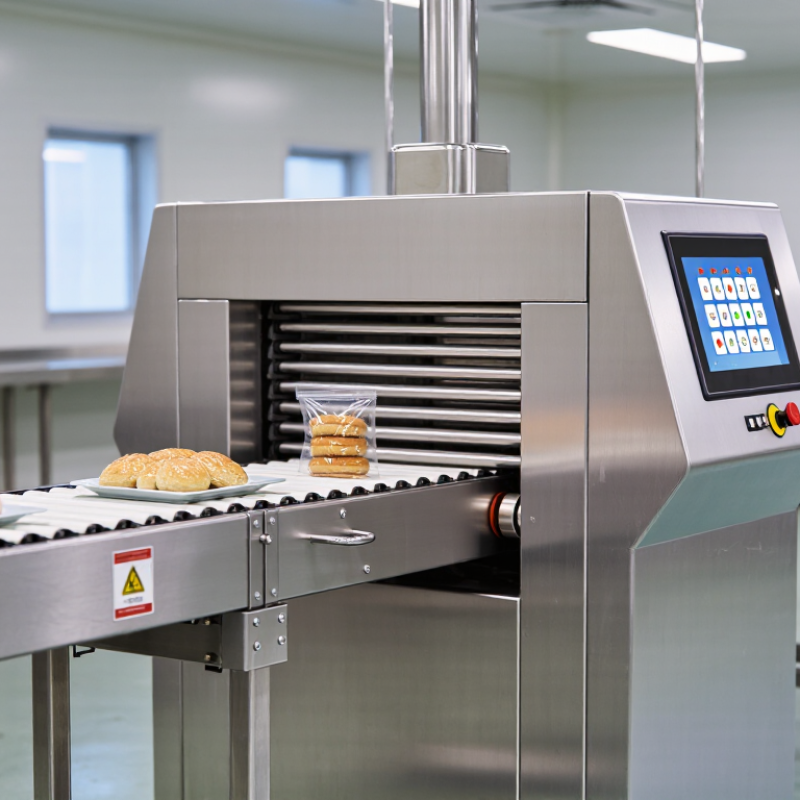
3 Wide-belt bakery X-ray system 500–700 mm wide × 180–300 mm high 80–180 packs/min 20–50 m/min Metal, glass, mineral stone, and calcified bone; practical sensitivity varies with product thickness IP65 Wide inspection zone, belt-load monitoring, recipe management, and optional dual-lane rejection US$60,000–110,000 Good balance of coverage, capacity, and flexibility for bakery plants
4 Meat and poultry packaged-product X-ray system 400–600 mm wide × 200–350 mm high 40–120 packs/min 15–35 m/min Metal, glass, stone, and bone fragments; detection performance depends heavily on product density and thickness IP66–IP69K Heavy-duty conveyor, hygienic construction, product-zone monitoring, and robust automatic rejection US$75,000–140,000 Best suited to demanding wet-washdown and high-risk protein applications
5 Frozen-food X-ray inspection system 400–600 mm wide × 200–350 mm high 40–100 packs/min 15–35 m/min Metal, glass, stone, and bone; sensitivity is affected by ice content, product overlap, and package height IP66–IP69K Condensation-resistant design, cold-temperature conveyor components, strong image contrast, and washdown capability US$80,000–150,000 High value where cold-chain contamination risks and harsh cleaning are major concerns
6 Bulk-flow X-ray system 300–500 mm wide × 100–250 mm high 1–5 tonnes/hour 20–60 m/min Metal, glass, stone, and dense foreign material; minimum size depends on material distribution and layer depth IP65–IP66 Continuous-flow inspection, air-blast or diverter rejection, contamination mapping, and low product loss US$70,000–135,000 Efficient for ingredient protection before mixing, processing, or packaging
7 Pumped-liquid and semi-liquid X-ray system Pipeline or container opening of 100–300 mm 1–8 tonnes/hour Application-dependent Metal, glass, stone, and dense foreign material in bottles, jars, cans, or pipeline products IP66–IP69K Hygienic contact surfaces, container inspection, fill-level checking, cap inspection, and automated line integration US$85,000–170,000 Suitable for processors requiring contamination and packaging checks in one inspection stage
8 Large-format carton and case X-ray system 600–900 mm wide × 300–500 mm high 20–80 cases/min 10–25 m/min Metal, glass, stone, and dense bone; large tunnel dimensions generally reduce achievable sensitivity IP65 Large tunnel aperture, case-count verification, missing-product detection, and multi-product inspection US$100,000–190,000 Best for case-level inspection where opening size is more important than maximum sensitivity
9 Can, jar, and bottle X-ray inspection system 300–500 mm wide × 200–400 mm high 80–240 containers/min 20–60 m/min Metal, glass, stone, and product-contamination defects; performance depends on container geometry and wall thickness IP65–IP69K Container orientation control, fill-level analysis, missing-cap detection, seal inspection, and reject verification US$90,000–180,000 Strong choice when food safety and container-quality inspection are both required
10 Advanced dual-energy X-ray system 400–700 mm wide × 200–400 mm high 50–180 packs/min 15–50 m/min Enhanced material discrimination for organic and inorganic contaminants; actual sensitivity must be validated with product samples IP66–IP69K Dual-energy imaging, advanced software classification, density compensation, detailed audit trails, and networked quality data US$130,000–250,000+ Best performance potential for difficult products, with the highest initial investment

* Detection capability: These are typical engineering ranges rather than guaranteed specifications. Actual results depend on product density, package size, orientation, conveyor loading, X-ray power, detector configuration, and validation samples.

** Indicative purchase cost: Approximate equipment-only ranges in US dollars for new food-grade systems. Installation, shielding, conveyors, reject devices, software integration, validation, training, and service contracts may increase the total project cost.

Safety, Compliance, and Maintenance Considerations for Buyers

Selecting an X-ray machine for food production requires more than comparing detection sensitivity. Buyers should examine product type, line speed, packaging, and the smallest expected contaminant. In practical plant assessments, stainless-steel construction helps cleaning teams work around flour, oil, and washdown water. The tunnel should limit access to the beam and include functioning guards, warning lights, and emergency stops. Operators need clear training, not just a laminated instruction sheet. Short drills can confirm safe responses when an alarm stops the conveyor. Small details matter. Radiation safety should be verified by qualified personnel under applicable local requirements.

Compliance depends on documented control, not attractive specifications. Ask for installation records, factory test results, calibration procedures, and service documentation. The machine should fit the site's hazard analysis and established food-safety plan. Validation must use certified test pieces that represent actual products and packaging. Run tests at different speeds and positions, because one successful check proves little. Keep results, rejected samples, corrective actions, and operator training records accessible. A certificate alone is not enough. Different jurisdictions may set different radiation, electrical, and food-contact expectations, so local review remains essential.

Maintenance planning often decides whether a detector earns its cost. Inspect belts, curtains, sensors, guards, and reject mechanisms during routine checks. Clean according to the equipment's rating, then verify that seals and covers remain intact. Schedule performance tests and calibration with competent technicians, especially after repairs or relocation. Keep critical spare parts available, and agree on realistic response times before purchase. Perfect uptime is unrealistic. I would question any sales promise that ignores false rejects, downtime, or difficult cleaning. A slightly slower machine may deliver better reliability when staff can maintain it correctly.

Any Questions? We Are Here for You

Contact Us

Contact Us

Request information

Ask us a question
Service Support

Service Support

Available 24 hours a day, 7 days a week.

Get in Touch
Find a representative

Find a representative

Contact your local representative

View Locations