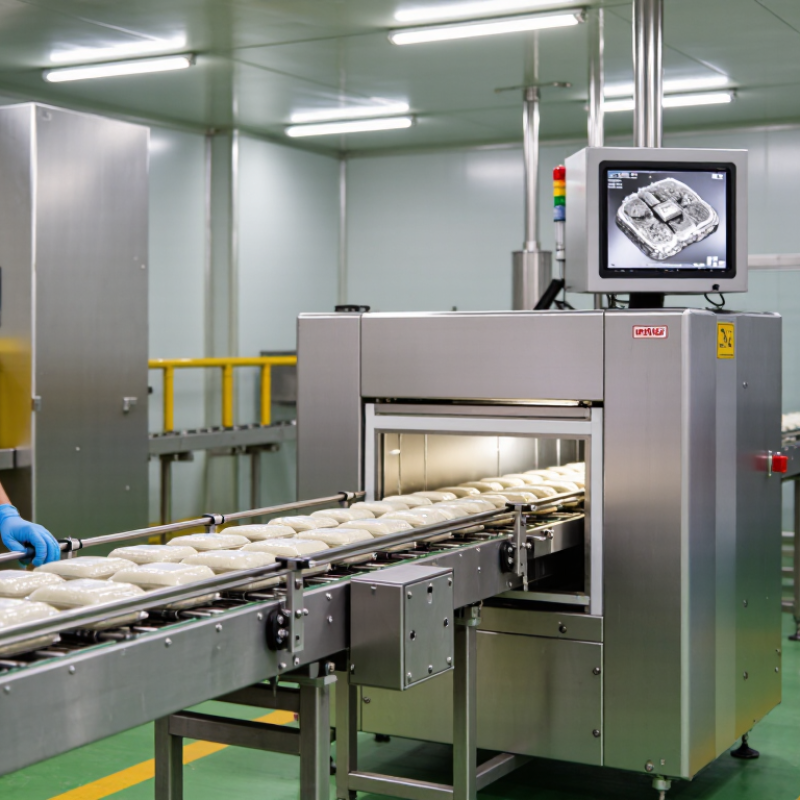
| 1 |
Confirm that the supplier has a documented hazard analysis covering physical hazards. |
Hazard analysis completeness |
Approved hazard analysis, process-flow diagram, product description, and documented preventive controls for foreign material. |
All processing steps, raw materials, packaging materials, and rework streams are assessed. X-ray inspection is identified as a control only where the hazard analysis demonstrates that it is suitable. |
At initial approval and whenever the product, process, equipment, or applicable regulation changes. |
| 2 |
Verify that the X-ray system is installed at an effective control point. |
Control-point suitability |
Process-flow location, product temperature, line speed, product orientation, pack format, and reject-device description. |
The system is positioned after the last reasonably foreseeable source of physical contamination and before final case packing or shipment, unless the validated process requires another location. |
During technical approval, annual reassessment, and after layout or process changes. |
| 3 |
Review validated detection performance using certified test pieces. |
Detection sensitivity |
Validation report showing test-piece material, size, position, product type, product height, belt speed, and operating settings. |
Validation must cover the most difficult product and package configuration. Reported sensitivity is product-specific; there is no single universal X-ray detection size for all foods. |
At commissioning, after major equipment or product changes, and at least annually. |
| 4 |
Check routine challenge testing and automatic rejection. |
Challenge-test pass rate |
Test log for ferrous, non-ferrous, and stainless-steel test pieces where relevant, including test position and reject confirmation. |
Target: 100% of scheduled challenges detected and rejected. Any failed challenge requires product isolation, documented investigation, corrective action, and disposition of potentially affected product. |
At start-up, after breaks or stoppages, at product changeover, and at the end of production; follow the validated site procedure. |
| 5 |
Confirm that rejected product is controlled and traceable. |
Reject management |
Reject-bin access controls, alarm records, reject counts, disposition records, and batch or lot identification. |
Rejected units are automatically diverted or securely contained, clearly identified, protected from re-entry, and reconciled against production records. No unexplained reject loss is accepted. |
Every production shift and during each supplier audit. |
| 6 |
Evaluate calibration, preventive maintenance, and equipment verification. |
Equipment reliability |
Calibration certificates, maintenance schedule, service records, software or parameter-change history, and verification results. |
Calibration and maintenance are completed by competent personnel according to documented intervals. Overdue critical activities should be treated as a nonconformance until risk is assessed. |
Review monthly for critical equipment and during every supplier performance review. |
| 7 |
Check alignment with destination-market food-safety requirements. |
Regulatory and customer compliance |
Applicable legal register, export-market requirements, food-safety plan, product specifications, and corrective-action records. |
The supplier demonstrates compliance with applicable requirements such as preventive-control or HACCP-based systems, traceability obligations, hygiene controls, and physical-contamination controls. Local legal requirements take precedence over buyer benchmarks. |
Before approval, at least annually, and whenever destination-market rules change. |
| 8 |
Measure supplier performance with objective quality indicators. |
Supplier KPI scorecard |
Shipment volume, foreign-material complaints, X-ray rejects, inspection failures, audit findings, and on-time corrective-action closure. |
Suggested buyer targets: zero confirmed foreign-material incidents, 100% completion of scheduled X-ray tests, at least 95% on-time corrective-action closure, and no overdue critical findings. |
Monthly trend review and formal quarterly supplier evaluation. |
| 9 |
Verify end-to-end lot traceability and mock recall capability. |
Traceability response time |
Raw-material lot records, production records, X-ray inspection logs, finished-product codes, shipping documents, and mock-recall report. |
All affected lots can be identified from supplier to customer and backward to raw materials. A buyer-defined target of four hours or less for a documented mock-trace exercise is a practical benchmark, subject to local requirements. |
At least annually and after major traceability-system changes. |
| 10 |
Assess corrective-action effectiveness after alarms, failures, or complaints. |
Root-cause and CAPA effectiveness |
Incident report, affected-lot assessment, root-cause analysis, immediate containment, corrective action, preventive action, and effectiveness verification. |
Critical incidents are contained immediately; affected product is placed on hold pending risk assessment. Corrective actions should have an owner, due date, evidence of completion, and documented verification that recurrence risk has been reduced. |
For every incident; trend analysis monthly and management review at least quarterly. |

.svg)